
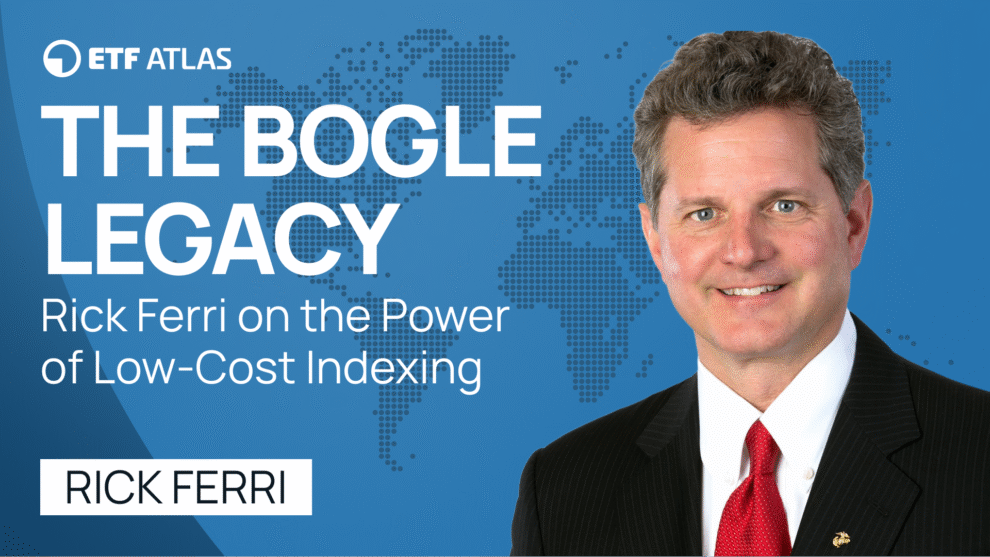
In this insightful interview with ETFatlas.com, Rick Ferri, a renowned figure in the investment world, shares his wisdom on index investing and financial advice. Drawing from his extensive experience, Ferri discusses the principles of successful investing, the importance of simplicity in portfolio management, and his critique of traditional fee structures in the financial industry. He also reflects on the lasting impact of John Bogle’s philosophy and offers valuable guidance for both individual investors and financial advisors. This conversation provides a wealth of knowledge for anyone looking to navigate the complex world of investing with clarity and purpose.
Key topics covered in this episode:
- Rick Ferri’s transition from Marine Corps fighter pilot to investment expert
- The three pillars of successful investing: philosophy, strategy, and discipline
- Critique of active management and complex investment strategies
- The benefits and misconceptions of index investing
- Ferri’s perspective on managed futures and trend-following ETFs
- The importance of simplicity in portfolio construction
- Criticism of asset under management (AUM) fees and advocacy for hourly consulting
- Reflections on John Bogle’s influence and the “majesty of simplicity” in investing
- The democratization of wealth-building through index funds
- Advice for investors on developing a sound investment philosophy and strategy
Recommended Resources
- rickferri.com – Rick Ferri’s official website where you can find his books, podcasts, articles, and contact information
- bogleheads.org – Forum for discussing Bogle’s investment philosophy and index investing
- ETFatlas.com – Comprehensive database for ETFs domiciled in the United States, Europe, and Canada
- vanguard.com – Official website of Vanguard, offering low-cost index funds and ETFs
- Bogleheads’ Guide to Getting Started – Wiki page with basic information on index investing
- The Little Book of Common Sense Investing – Book by John C. Bogle on index fund investing
- morningstar.com – Resource for investment research and analysis
Video and podcast
Listen to “The Bogle Legacy: Rick Ferri on the Power of Low-Cost Indexing” on Spreaker.
Episode Overview
In this enlightening episode, we had the privilege of speaking with Rick Ferri, a renowned figure in the world of investing. Rick shared his journey from being a Marine Corps fighter pilot to becoming a respected voice in finance, offering valuable insights into successful investing strategies.
Insights on Index Investing
Rick clarified the distinction between index investing and passive investing, explaining how the term “index” has been diluted in recent years. He advocated for traditional benchmark indices that are cap-weighted and all-inclusive, emphasizing their low cost and broad diversification.
On Portfolio Construction
Rick stressed the importance of simplicity in portfolio construction. He criticized the tendency of some advisors to overcomplicate portfolios, especially in taxable accounts, for the sake of job security. Instead, he recommended using a few well-chosen, low-cost index funds to capture market returns efficiently.
Fee Structures and Financial Advice
Rick discussed his critique of asset under management (AUM) fees, proposing a model where portfolio management fees and financial advice fees are separated. He argued that this approach aligns fees more fairly with the work advisors actually do, rather than basing them solely on the amount of money a client has invested.
Lessons from John Bogle
Reflecting on his interactions with John Bogle, Rick highlighted two key lessons: the importance of aligning interests between fund companies and investors, and the “majesty of simplicity” in investing. He praised Bogle’s foresight in creating Vanguard as a client-owned company and his emphasis on keeping investment strategies straightforward.
Advice for Investors
Rick summarized his advice for investors into three key principles: developing a sound investment philosophy, creating a clear strategy, and maintaining discipline. He emphasized that following these principles with a focus on simplicity and low costs can lead to better long-term results than more complex approaches.
Conclusion
This episode provided a wealth of knowledge for both novice and experienced investors. Rick Ferri’s insights, shaped by decades of experience and a commitment to client-focused investing, offer a compelling case for simplicity, discipline, and cost-efficiency in building long-term wealth. His perspective challenges many conventional practices in the financial industry and provides a roadmap for investors seeking to navigate the complex world of finance.