
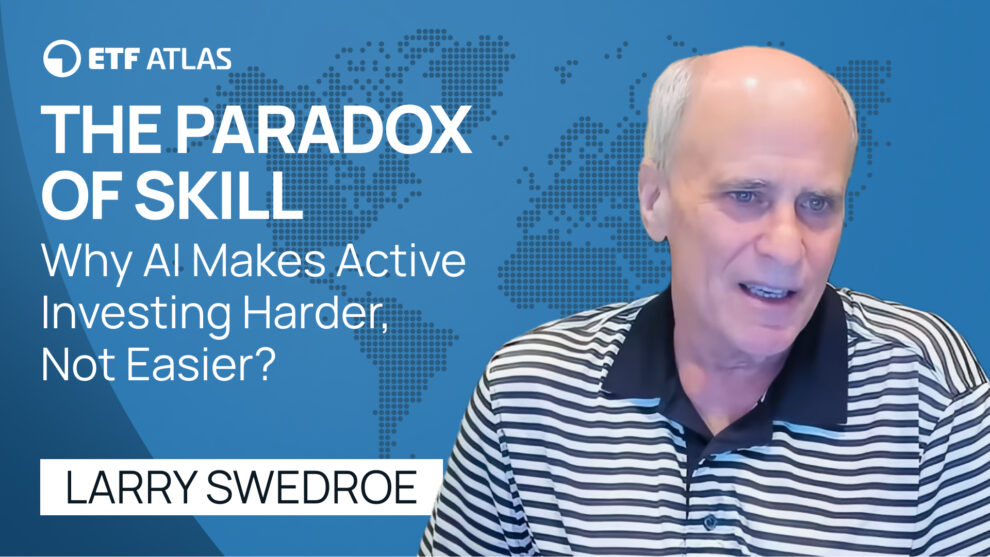
In this second round with Larry Swedroe, a renowned advocate for evidence‑based investing and author of multiple books on finance, we dive deeper into the mechanics of market returns and what evidence‑based investing means in today’s late‑2025, AI‑driven markets. Larry explains the paradox of skill, where rising market expertise, boosted by AI and machine learning, makes outperforming even tougher. Drawing from his book “The Incredible Shrinking Alpha”, he argues that today’s competition and technology push traditional stock picking to the brink by making markets ever more efficient.
As the aggregate skill level of market participants rises, the ability to outperform actually falls, and luck plays a bigger role in who wins.
We explore how the value factor fits with academic theory and how its implementation needs to adapt to an economy dominated by intangible assets rather than relying on the idea of timeless “genius stock picks”. Larry stresses that investors are not competing one‑on‑one, but against the collective wisdom of highly skilled institutions. He also addresses the rise of passive investing, arguing it does not create easy inefficiencies but rather exposes active management as a loser’s game for most participants.
The conversation turns to geopolitics and market fragmentation, where Larry notes that even in small caps, international, or emerging markets, the data shows no better persistence of outperformance once costs are considered. We revisit his Substack posts on momentum, private credit, and the goodwill trap and discuss why blending value and momentum can build more resilient portfolios by avoiding negative‑momentum value traps. Larry also warns about high fees in private equity and private credit, and points listeners toward more democratized, factor‑like approaches from firms such as AQR, Blackstone, and Cliffwater to access similar premiums more efficiently.
If the critics of passive were right, as passive grew the percentage of active managers outperforming should have gone up. The evidence shows exactly the opposite.
He echoes David Swensen’s critique of the asset management industry’s fee structures and conflicts of interest, highlighting how many investors effectively subsidize the system. The conversation also touches on quantum computing as a tail risk for financial systems and cryptocurrencies, reinforcing Larry’s skepticism toward crypto as a safe haven. Finally, Larry encourages a shift in mental models: away from chasing elusive alpha and toward disciplined, diversified exposure to proven factors, complemented by alternatives such as reinsurance, private credit, and factor‑based alternative strategies that offer low correlation to traditional equity and credit risks.
Any time you think you have some insight about geopolitics or China decoupling, you have to ask: gee, am I the only one who knows this, or do Citadel and Goldman know it too? And can I really interpret it better than they can?
Agenda
- Introduction to the episode’s focus on the “why” of evidence‑based investing in late 2025.
- Revisiting Larry Swedroe’s books:
- Discussion on whether AI has killed stock picking through Michael Mauboussin’s paradox of skill
- Explanation of why rising skill levels make outperforming markets harder, using tennis and baseball analogies
- Analysis of institutional vs. retail investors and the shift from 1945 to today
- Examination of passive investing’s impact on market efficiency and active managers’ performance
- Exploration of geopolitics, de‑risking from China, and potential inefficiencies in fragmented markets
- Comparison of efficiency in small caps, international, and emerging markets
- Differentiation between information and value‑added knowledge in investing
- Discussion of quantum computing as a tail risk for financial systems and cryptocurrencies, and what it means for crypto as a “safe haven”
- Insights from Larry’s Substack on momentum, private credit, and the goodwill trap
- Argument for combining value and momentum factors to reduce costs and improve portfolio robustness
- Evolution of momentum strategies beyond the 12‑month window in AI‑driven volatility
- Critique of the asset management industry’s high fees and fiduciary issues, quoting David Swensen
- Recommendations for low‑fee alternatives in hedge funds, private equity, and credit from firms like AQR, Blackstone, and Cliffwater
- Advice for the next decade: Focus on diversified factors, low correlations, and discipline over outperforming
References and further reading
- Evidence-Based Investing: How Academic Research Transformed Investing (Larry Swedroe)
- Beyond the 12‑1 Rule: Rewriting the Momentum Playbook
- Enhancing Momentum Strategies
- Does High Goodwill Present a Hidden Risk in Your Portfolio?
- A Comprehensive Guide to the Private Credit Revolution
- The Strength of Private Debt
- The Quantum Computing Threat to Financial Systems and Cryptocurrencies
Video and podcast