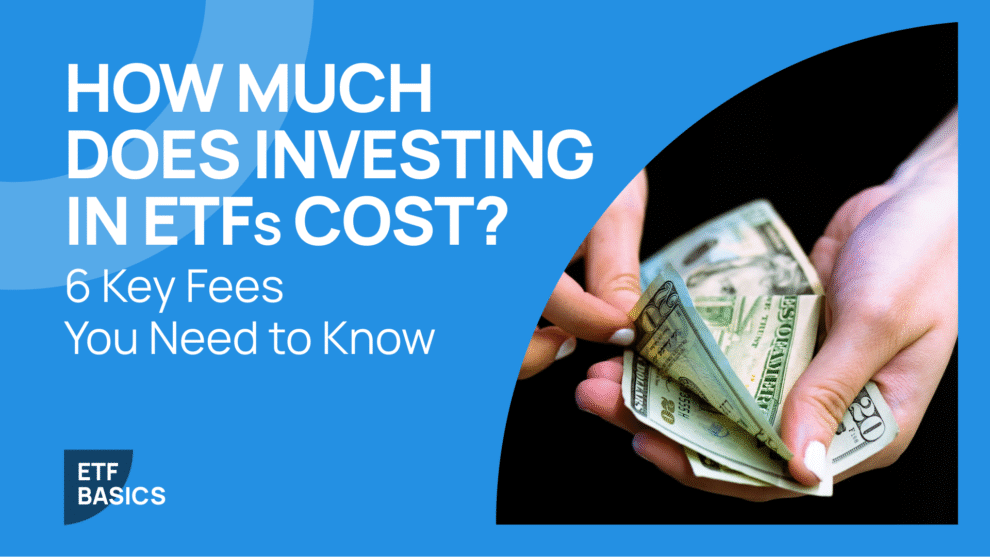
Exchange-Traded Funds (ETFs) are renowned for their low costs, which are typically many times lower than traditional actively managed funds. However, it’s important to remember that the management fee is only the tip of the iceberg. The true cost of investing consists of several components that can significantly impact your final return.
Below, we outline the 6 main categories of costs that ETF investors should be aware of.
1. Management Fees (TER)
The management fee, often expressed as the TER (Total Expense Ratio), is the primary cost borne by investors. It is automatically deducted from the fund’s assets, meaning you won’t see it as a separate line item on your account statement—it simply reduces the unit price of the fund.
- Low fees are a major advantage: This is ETF’s greatest strength. For example, an ETF tracking the global stock market (such as one from Vanguard) might cost just 0.06% annually, while traditional actively managed funds often charge fees several times higher (frequently exceeding 1%).
- Additional fund revenue: Some funds offset investor costs through securities lending mechanisms, where the fund lends its holdings to short sellers and retains the profits. Under favorable conditions, this can allow an ETF to slightly outperform the index it tracks.
- Variations by region: ETF costs vary by geography and regulatory environment. Generally, the most competitive pricing is found in markets with high competition and large asset bases, though regulation and market structure also play a role.
2. Brokerage Commissions
Since ETFs are exchange-traded instruments, you need a brokerage account to trade them. Each purchase or sale of units incurs a fee to your broker.
- Fee structures: Commissions can be charged as a percentage of the transaction (e.g., 0.19% of the trade value) or as a flat fee (e.g., $5 USD per transaction). This depends on your broker’s offering and the market on which you trade.
- Minimum commission trap: This is a pitfall for small investors. If your broker charges “0.19%, but no less than $10,” then on a $100 purchase you’ll pay $10—a 10% commission. To minimize this cost, invest less frequently but in larger amounts.
- Domestic vs. International brokers: Different brokers offer varying fee structures. Some brokers offer commission-free trading up to certain trading limits. Choosing a broker depends on your specific needs, the markets you wish to access, and any tax-advantaged accounts available in your jurisdiction.
3. Bid-Ask Spread
The bid-ask spread is the difference between the best asking price (the price at which sellers are willing to sell) and the best bid price (the price at which buyers are willing to buy) at any given moment. This is a hidden transaction cost—when you buy, you pay slightly more than you could receive if you sold at the exact same moment.
- Liquidity matters: Popular funds with high trading volumes typically have very tight spreads (costs are negligible). For ETFs tracking exotic markets or with smaller asset bases, the spread can be wider and more noticeable.
- Time horizon mitigates the issue: For long-term investors (“buy and hold”), the spread is a one-time, marginal cost. It is, however, critical for day traders executing multiple transactions daily.
- How to minimize costs: Use limit orders instead of market orders. This allows you to control the execution price, though there’s a risk the order won’t fill if the market moves away from your limit.
4. Currency Conversion Costs
Most attractive ETFs are denominated in major foreign currencies (EUR, USD, GBP). If your brokerage account is funded in your home currency, you’ll need to account for currency exchange costs.
- Broker currency conversion: Often convenient, but can be expensive. Brokers may charge wider spreads on currency conversions than specialized currency exchange services.
- Alternative approach: Check your broker’s fee schedule. If the currency spread is high, consider exchanging currency through a specialized provider (bank or online currency exchange) and transferring funds to your brokerage account in the desired currency (assuming your broker maintains multi-currency accounts).
5. Wire Transfer Fees
If you decide to fund your account in a foreign currency through an international bank transfer, be aware of the costs involved:
- Regional payment systems: Many regions have regional or inter-regional payment systems that offer lower-cost transfers (e.g., SEPA in Europe for Euro transfers). These are often free or very inexpensive, making investment in ETFs denominated in those currencies more cost-effective from a logistics perspective.
- International wire transfers: Transfers in other currencies are often subject to higher fees from both the sending bank and intermediary banks. This can significantly increase your investment costs, especially on smaller amounts.
6. Premium and Discount to NAV
The ETF’s price on the exchange is determined by supply and demand, while the actual value of the fund’s assets is its NAV (Net Asset Value). In an ideal world, these two values would always be identical, but in practice, discrepancies can occur.
- Premium: A situation where you pay more for the ETF than the underlying assets are worth.
- Discount: The opposite situation—you buy the ETF at a price lower than its underlying asset value (an opportunity).
This risk becomes apparent mainly during market panic or with funds that have poor liquidity. Under normal circumstances, thanks to market makers who actively trade to profit from any gaps, these discrepancies are minimal and quickly eliminated. To avoid buying at a significant premium, always check the iNAV (indicative NAV) and use limit orders for your purchases.
Key Takeaway: While ETFs are among the most cost-effective investment vehicles available, your total cost of ownership extends beyond the stated expense ratio. By being mindful of commissions, spreads, currency costs, and using strategies like limit orders and cost-effective payment methods, you can minimize these hidden expenses and maximize your returns over time.