
Have you ever wondered what connects the world’s biggest stock market billionaires? It’s not just access to insider information or extraordinary analytical intelligence, but above all, unwavering patience. The legendary Warren Buffett has repeatedly emphasized that “the stock market is a device for transferring money from the impatient to the patient.” In a world where everyone strives for instant gratification and social media bombards us with “opportunities of a lifetime,” the ability to wait has become a rare and valuable superpower. Patience is not passivity – it is an active shield that protects your capital from its greatest enemy: your own emotions.
Why is Patience the Foundation of Profit?
In investing, time is your greatest ally, and haste is your most effective saboteur. Statistics reveal a brutal truth: the majority of stock market gains are generated during just a few key moments of an investment’s lifespan. Attempts to “catch” these moments through constant buying and selling – known as market timing – usually end in failure.
Patience allows you to fully utilize the power of compound interest, as profits need time to start growing exponentially. As Warren Buffett notes, the greatest benefits come not from the growth itself, but from the duration of that growth. It also enables you to survive market storms because history proves that after every crash, a rebound follows sooner or later. Those who sell in a panic almost always deprive themselves of the chance to recover their losses. Furthermore, patience allows you to keep a cool head – the investor’s most valuable tool – ensuring decisions are made based on analysis and facts, not emotions or short-term impulses.
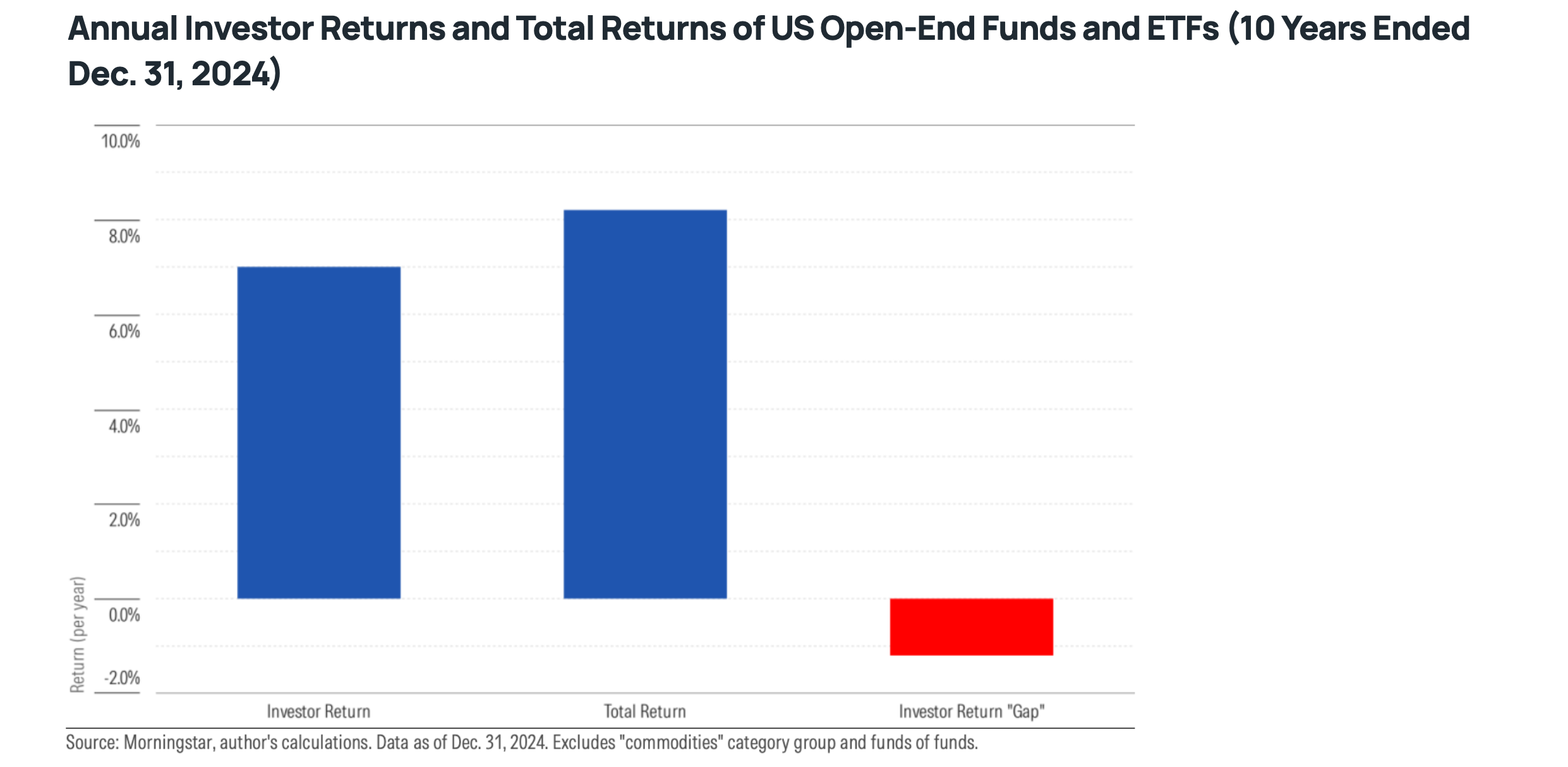
The Morningstar “Mind the Gap” study from 2025 shows that impatient investors lose an average of 1.2% annually due to bad decisions related to timing, excessive trading activity, or speculative use of funds. This isn’t theory – this is hard data from real portfolios.
Strategy as a Cure for FOMO (Fear of Missing Out)
The Fear of Missing Out (FOMO) is a powerful psychological force that pushes investors to buy at peaks (“everyone is making money, I have to get in now!”) and sell at bottoms. Patience is inextricably linked to having your own strategy and the consistency to execute it.
- When you have a plan, you know exactly what you are doing and why. You don’t react to every headline on a financial portal or post on X (Twitter).
- Consistency builds confidence: If your strategy involves long-term investing, temporary drops become opportunities for cheaper purchases, not reasons for panic.
- Ignoring the noise: A patient investor knows that most “news” is just noise. They focus on fundamentals and the long term, not on what a CEO or investment guru wrote on social media.
- Automating decisions: Having rules (e.g., “I buy every month for a fixed amount”) lifts the burden of constant decision-making and fights the temptation to “do something quickly.”
Psychological Traps That Ensnare the Impatient
A lack of patience is a straight road to financial disaster. Here are the mechanisms that destroy the portfolios of impatient investors:
- Overtrading: Frequent transactions are a sure way to… enrich your broker. Commissions and taxes eat up profits faster than you think. Studies confirm that the most active investors statistically achieve the worst results.
- The Emotional Rollercoaster: Impatience makes you a slave to your own emotions. You buy under the influence of greed (when it’s expensive) and sell out of fear (when it’s cheap). This is a classic recipe for losing money.
- The Illusion of Control: We think that by “doing something” (clicking “buy” or “sell”), we have control over the situation. In reality, in the capital market, the best decision is often… doing absolutely nothing and letting the capital work.
How to Train the “Patience Muscle”?
Patience is not an innate trait—it is a skill that can be trained like muscles at the gym.
- Change your perspective: Stop checking your account balance every day. If you are investing for 10 years, this week’s fluctuations do not matter.
- The “drying paint” test: If you can watch paint dry for hours and do nothing, you have the predisposition to be a great investor. Boredom in investing is good!
- Passive investing (e.g., using ETFs): This is a school of patience in practice. You buy the whole market and wait. This approach eliminates the temptation to constantly “tinker” with the portfolio composition.
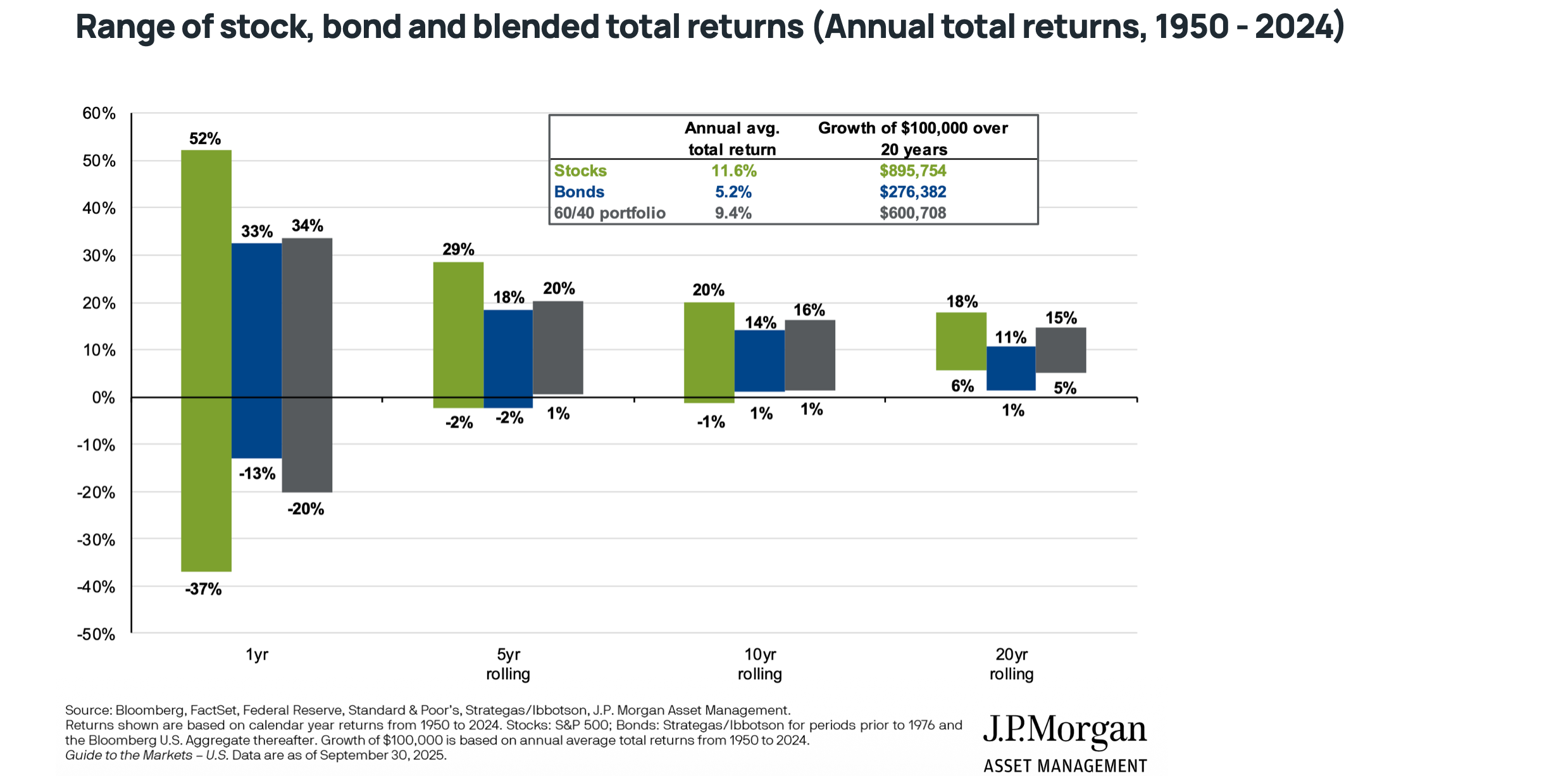
The chart below shows the dispersion of returns over a 1, 5, 10, and 20-year perspective for the US market. Conclusion: The longer you are in the market, the lower the risk of loss. In a 20-year perspective, historical data does not show a single period with a loss.
Balance: Patience is Not Ignorance
Patience is a virtue in investing, but only when accompanied by awareness and analysis. It does not mean blind stubbornness or passive waiting in the hope that everything will “fix itself.” In practice, it is about the ability to remain calm and consistent while maintaining vigilance regarding real changes in the investment environment. If a company loses financial stability, its business model stops working, or the industry it operates in experiences a permanent crisis – sticking with such a position is not a sign of patience, but a mistake. Patience should help an investor wait out temporary drops and periods of uncertainty, but it cannot lead to ignoring facts that undermine the logic of a given investment.
Patience without reflection leads to stagnation, and action without strategy leads to chaos. Therefore, the best solution is a regular portfolio review at specific intervals (e.g., once a quarter), during which decisions are made not due to emotions, but based on data and “dry” analysis.
Patience is meant to serve the strategy, not be an excuse for a lack of oversight. It is conscious waiting, backed by an understanding of market mechanisms and the conviction that the most gain comes to those who combine calm with the ability to react when the facts change.
Win the War Against Yourself
Investing is 90% psychology and 10% mathematics. The biggest challenge is not choosing the “perfect” company, but sticking with your choice when the whole world screams “sell!” or “buy!”. Patience is the quiet strength that allows you to ignore that scream.
“The big money is not in the buying or the selling, but in the waiting.”
– Charlie Munger
Key Takeaways:
- Time is money: Give your investments time to grow; compound interest needs years, not days.
- Strategy is a shield: Having a plan is the best defense against the FOMO virus and crowd panic.
- Less is more: Limiting the number of transactions usually leads to higher profits.
- Emotions are the enemy: Decisions made on impulse are rarely accurate; cool calculation takes time.
- The persistent win: The history of financial markets is a history of rewarding those who knew how to wait out difficult times.