
In 2000, an Intel executive had a net worth of more than USD 10 million. Apart from his home, almost all of it was in Intel stock. Nine years later the stock was worth about 75% less, and he still would not sell even a small part. “Surely Intel will come back,” he told Larry Swedroe, an investment advisor who tried three times over those nine years to change his mind.
Intel did come back. In June 2026 its share price set an all-time high. Even so, USD 10 million left in Intel stock since early 2000 would have grown to only about USD 16 million by November 20, 2026. In a plain S&P 500 index fund, it would have grown to nearly USD 80 million, about five times as much.
A man who knew almost everything about his company lost to a fund that knew nothing about it. His story matters today, when many of us feel as sure about AI companies as he felt about Intel (AI ETF rankings: US · Europe).
The story comes from Swedroe’s book Enrich Your Future (2024). We added the backdrop of the 1990s and the sequel up to November 2026. We calculated the dollar amounts ourselves, with dividends reinvested (each payout buys more shares).
The 1990s: a company whose future seemed settled
The executive’s confidence is easier to understand if we go back a decade. USD 1,000 invested in Intel at the end of 1989 had grown to almost USD 39,000 by the end of 1999. In an index fund tracking the S&P 500 (500 large US companies), the same USD 1,000 grew to just under USD 5,300.
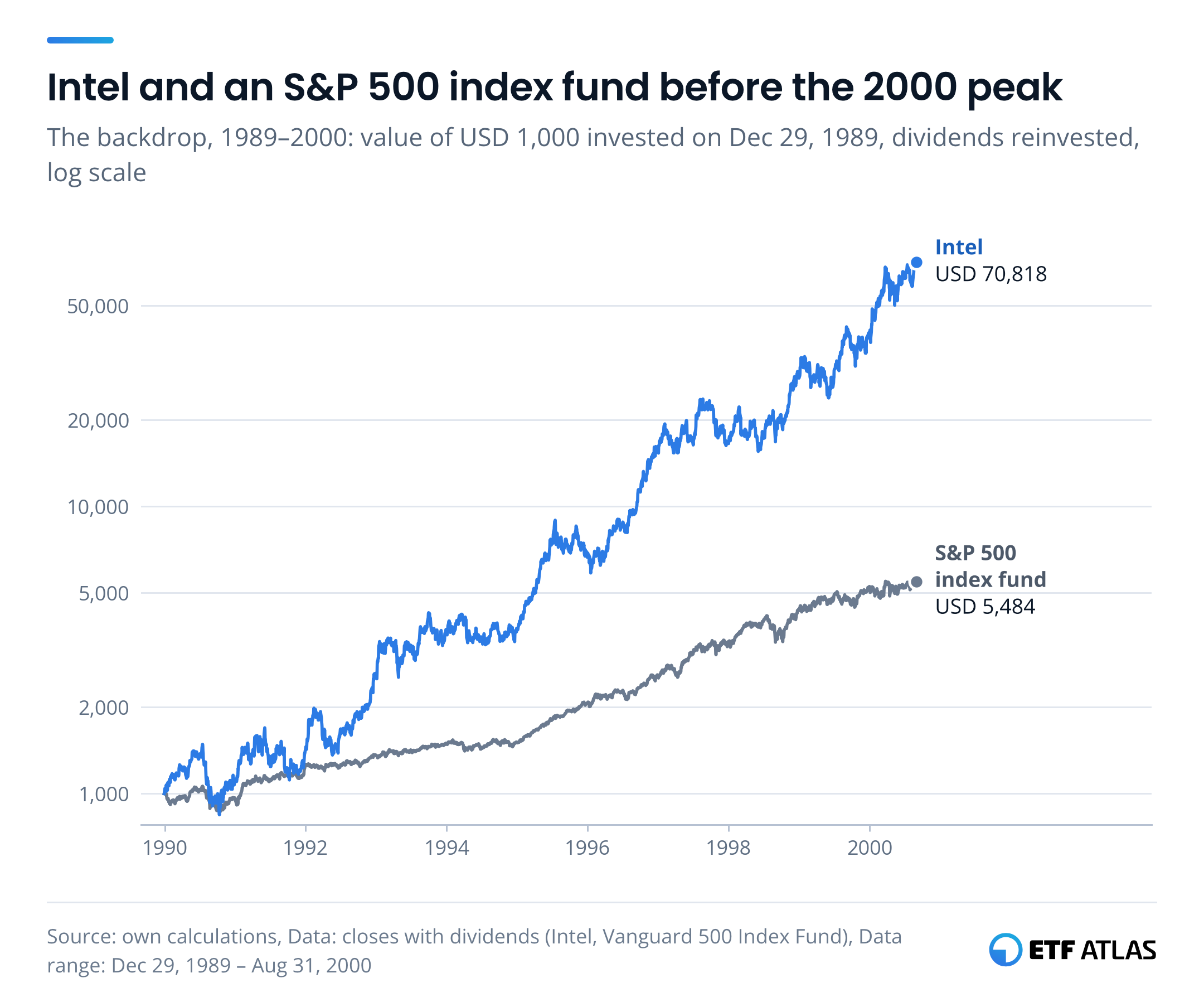
Eight months later, at the peak of August 31, 2000, Intel stock was worth more than 70 times the amount invested in 1989. The vertical axis is logarithmic, so equal distances mean equal percentage changes.
The results backed up the share price. In December 1997, Time magazine wrote that Intel made nearly 90% of the planet’s PC microprocessors. In 1999 the company posted record revenue of USD 29.4 billion and net income of USD 7.3 billion, according to its annual report. On November 1, 1999, Intel and Microsoft became the first Nasdaq stocks in the Dow Jones Industrial Average, a 103-year-old index of established US companies.
Intel put its ambition into one sentence of that report: to be “the preeminent building block supplier to the worldwide Internet economy.” The internet would grow, and every server and computer needs a processor.
What was that future worth? The answer depended on one assumption
In May 1999, as Swedroe recounts, Professor Bradford Cornell valued Intel stock at a conference of financial economists. He took public forecasts of the cash Intel would generate and changed one input, the equity risk premium. That is the extra return over safe government bonds that investors demand because stocks can disappoint. The more they demand, the less they pay today for the same future cash.
With a premium of 3%, a share was worth USD 204; at 5%, USD 130; and at 7.2%, only USD 82. On the market it cost about USD 120. These prices predate later stock splits, which multiplied the number of shares, so they cannot be compared with the prices further down.
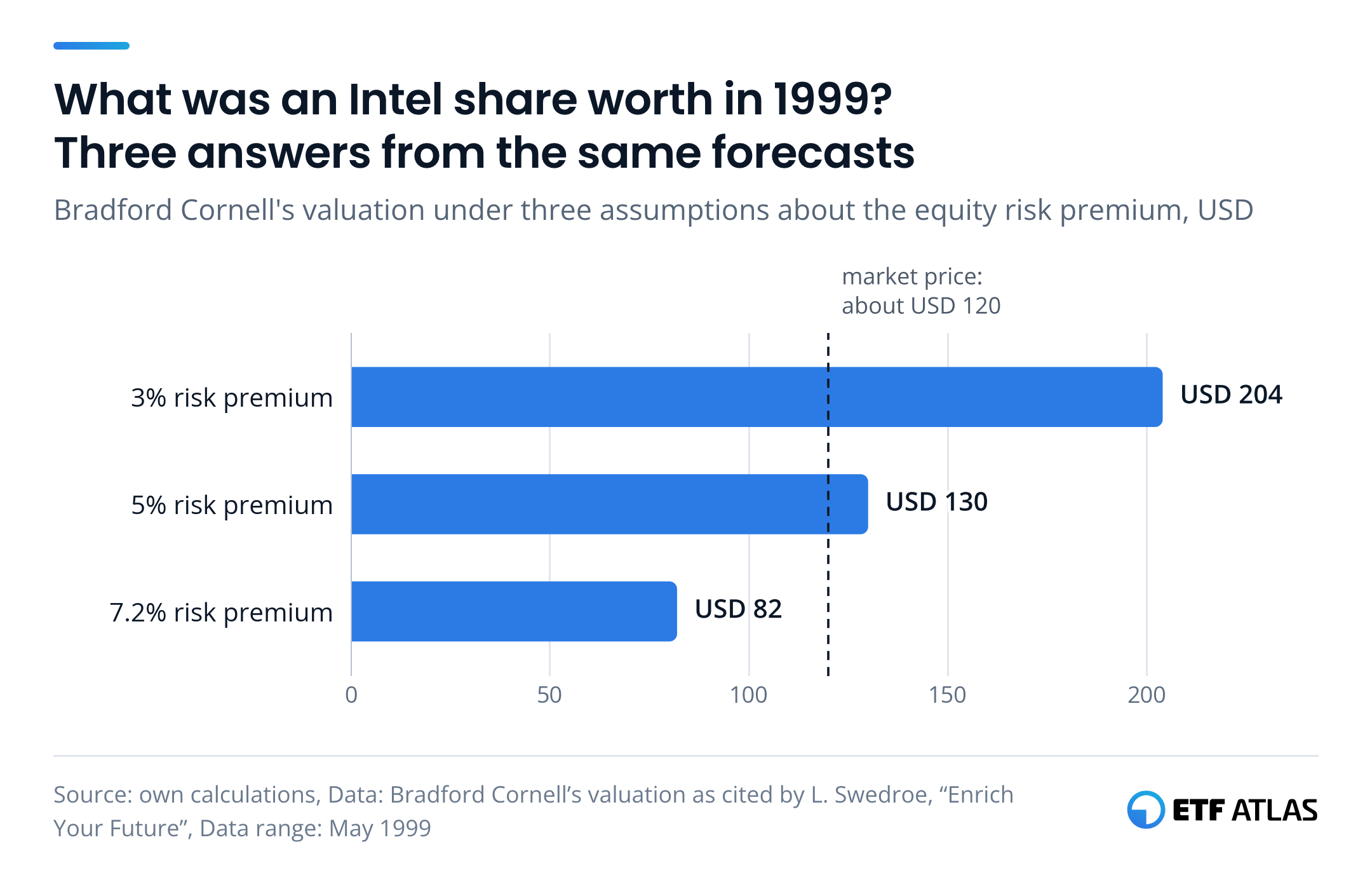
The same forecasts gave three different answers. At the lowest premium the share looked cheap; at the highest, expensive.
Even the best knowledge of a company does not settle which of the three valuations is right. Nobody knows what premium the market will demand a year or five years from now.
A year later, amid the tech-stock euphoria, hardly anyone was asking that question. In August 2000, Cornell noted in a November 2000 paper, Intel was the only company in the world worth more than USD 500 billion. Nearly every analyst covering Intel recommended the stock, according to a Bloomberg index.
Atlanta, 2000: the executive would not sell even part of his stock
In the spring of 2000, Swedroe came to Atlanta to give a seminar and met the Intel executive. It was the first of three conversations. The executive, Swedroe writes, was “so confident in the outlook for his company that he would not consider selling even a small percentage of his stock.”
It is hard to blame him. The market, the analysts, and the press were telling him what he already believed. Swedroe has seen many employees keep as much as 80–90% of their net worth in their employer’s stock.
We assume a round USD 10 million in Intel stock and, like Swedroe, start at the market close on February 29, 2000. That date is near the top of the tech-stock boom, which is hard on Intel, but it is when the executive chose to hold. A share cost USD 32 that day (from here on, share prices are adjusted for stock splits and dividends). Next to Intel we put the fund Swedroe used, the Vanguard 500 Index Fund.
For the first six months the executive was right. The share price peaked on August 31, 2000. That day the USD 10 million would have been worth USD 13.3 million, against USD 11.2 million in the fund.
September 2000: a record quarter and a 22% fall in one day
On September 21, 2000, after the market closed, Intel lowered its forecast. Sales were still growing, only more slowly. Third-quarter revenue would be 3–5% higher than in the second quarter, not 7–9% as Intel had forecast earlier, according to Cornell. The next day the stock fell 22% (Associated Press). After three trading days the drop reached 29.6%, and USD 122 billion of market value was gone.
The quarter still set a record: in October 2000 Intel reported revenue of USD 8.7 billion, 19% more than a year earlier. The share price fell because sales were growing more slowly than the market had already paid for.
The slowdown surprised the company itself. One of its executives could hardly have known more. Swedroe writes that “it is only surprises, which by definition are unpredictable, that provide an advantage.” On our podcast he explained why AI makes active investing harder, not easier.
At the bottom, on October 8, 2002, a share cost USD 7.56. The USD 10 million would have been worth USD 2.4 million, or 76% less, against USD 6.0 million in the index fund.
Around that time Swedroe met the executive again. The stock, he writes, had fallen about 75%, and the executive still would not sell.
March 2009: “Surely Intel will come back”
Nine years after the first conversation, in March 2009, Swedroe heard a third refusal. Weeks earlier, on February 23, 2009, Intel stock had hit its financial-crisis low. The USD 10 million from 2000 would have been worth USD 2.4 million that day, the same as at the 2002 bottom. In the index fund it would have been USD 6.3 million.
“Surely Intel will come back,” the executive said. Swedroe pointed out that executives of now-bankrupt companies had said the same thing.
By 2009 it was clear how far expectations had drifted from reality. Before the forecast cut, Cornell calculated, the price required revenue growth of nearly 20% a year for ten years, to about USD 170 billion. Intel’s revenue in 2009 was USD 35.1 billion, 4% more than in 2000. Investors had paid for a company with almost five times the revenue Intel actually achieved.
The company grew for 20 years, and the shareholder still lost to the index
On one point the executive was right: Intel survived and grew. In 2020 it had record revenue of USD 77.9 billion and net income of USD 20.9 billion (company releases). Revenue was more than twice its 2000 level, and net income almost twice.
The share price, dividends included, did not return to its starting level until October 2, 2017, after 17 and a half years. Our hypothetical shareholder would then have had USD 10.1 million, against USD 25.6 million in the fund.
Swedroe ran the numbers through September 2020. From March 2000 the index fund returned 6.4% a year and Intel 1.8%. Our calculations give the same rates. The USD 10 million would have become USD 14.5 million in Intel stock and USD 35.9 million in the fund. Without dividends, the Intel shareholder would have had less than USD 10 million: the entire gain came from dividends.
The market had paid in advance for growth of nearly 20% a year. Intel grew its revenue a little over 4% a year for two decades. A great company first has to grow into its high price before its stock can return more than the market.
2020–2026: an all-time high and a 29% fall in one day
Then the business slipped. In 2020 Apple announced it would move the Mac to its own processors, and Intel admitted it was running late with its new manufacturing technology. In August 2024 Intel suspended the dividend it had paid since 1992. It ended the year with a net loss of USD 18.8 billion (company releases). In November 2024 Nvidia took its place in the Dow.
In 2025 the US government took a 9.9% stake in Intel, and Nvidia said it would buy USD 5 billion of Intel stock. In 2026 the stock surged. On June 22 it set an all-time high of USD 140.94, more than three and a half times its first close of the year. The USD 10 million from 2000 would have been worth USD 43.9 million that day. Even then, that was only about half (51%) of the USD 85.9 million in the index fund.
On October 29, 2026, Intel reported third-quarter results. Revenue was up 21% year over year, but the forecast for the next quarter was weaker than expected (CNBC). The next day the stock lost 28.6%. As in September 2000, growing sales did not protect the share price.
On November 20, 2026, a share cost USD 51.28, 64% below the record. Our USD 10 million would have been worth USD 16.0 million, against USD 79.8 million in the index fund. Over 26 years and 9 months, that is 1.8% a year for Intel and 8.1% for the fund.
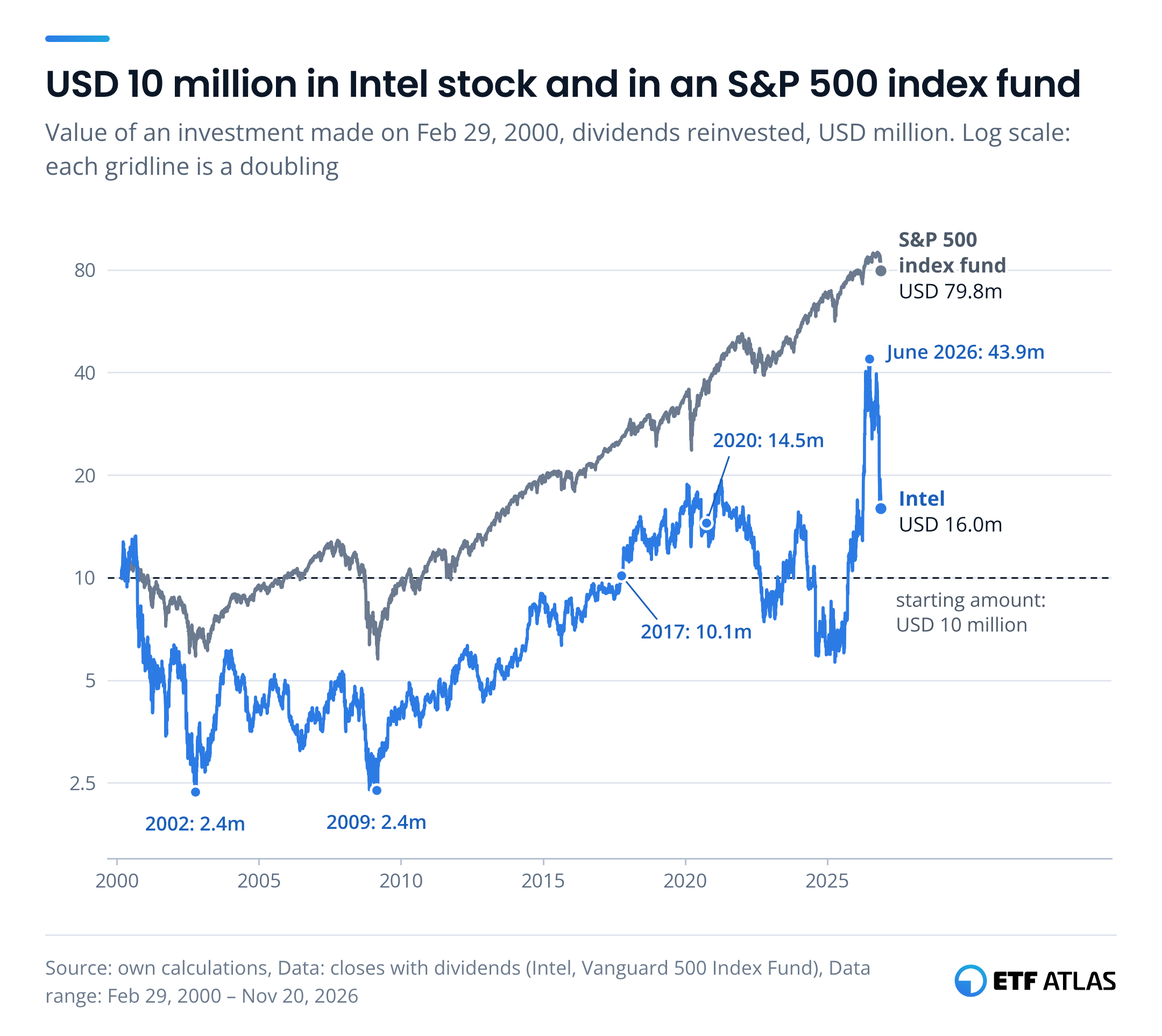
Twice, in 2002 and 2009, the Intel line drops to USD 2.4 million. Most of the time it runs below the dashed line of the starting amount. Even its June 2026 peak does not reach the fund’s line.
What the executive did not know, though he knew almost everything about Intel
To beat the index, the executive would have had to know in advance:
- In 2000: that the share price assumed sales growth of nearly 20% a year, when the real figure would be a little over 4%.
- In September 2000: that demand would weaken, before Intel itself found out.
- In 2026: the day the rally would end and a 64% fall would begin.
Each of these also surprised the people who knew the company best.
On 72% of trading days from February 2000 to November 2026, our USD 10 million in Intel stock was worth less than USD 10 million. That includes reinvested dividends.
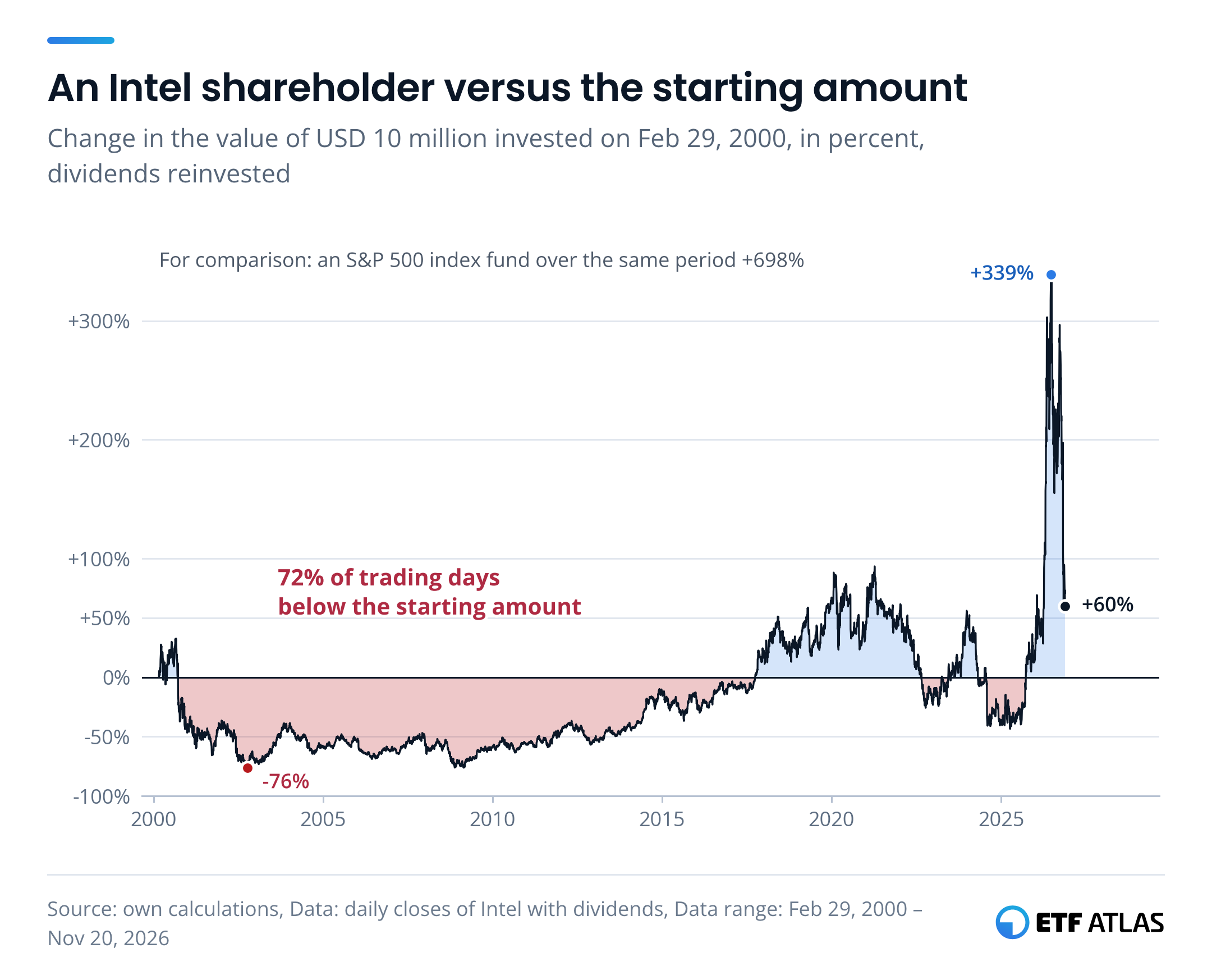
Red marks the days when a shareholder from 2000 had less than he had invested. The last such day was in September 2025.
How to check whether you are sitting in the Intel executive’s chair
According to Swedroe, no more than a small percentage of your assets, perhaps 10%, belongs in the stock of any one company, especially your employer. These questions help you assess a larger position:
- How much it really is: what percentage of your total net worth depends on one company?
- The cash test: if you held cash today instead of these shares, would you use all of it to buy them at the current price?
- What if you are wrong: when a company does badly, an employee can lose savings and a job at the same time.
A broad-index ETF spares you these questions: it spreads your money across a whole index, so no single surprise decides the result. Which ETFs you can buy depends on your broker. In the US that means US-listed ETFs. In the EU, the UK, and Switzerland it generally means UCITS ETFs (funds regulated under EU rules, usually domiciled in Ireland or Luxembourg). In Canada and Australia, locally listed and US-listed ETFs are the usual choice.
One option is an S&P 500 ETF. The longest-running is the US-listed SPDR S&P 500 ETF Trust, launched in 1993; in Europe, iShares Core S&P 500 UCITS ETF USD (Dist), 2002. Another is a broader, global stock ETF (the US-listed iShares MSCI ACWI ETF, 2008; in Europe, SPDR MSCI All Country World UCITS ETF, 2011). We compare the two baskets in Global Stocks vs US Stocks. Compass, the ETFatlas portfolio tracker, shows how much of your portfolio sits in its largest positions.
Lessons for investors
- Knowing a company is not an edge in itself: the executive knew Intel from the inside. The share price moved on surprises that even the company did not foresee.
- A good company and a good investment are two different things: Intel more than doubled its sales in 20 years. A shareholder from 2000 earned 1.8% a year, because the price had assumed much faster growth.
- “It will come back” is not enough: Intel set an all-time high. Even on that day the same amount in an index fund would have been worth about twice as much.
- Your employer can count twice in your finances: your salary and your shares depend on the same company.
Past performance does not guarantee future results. All amounts are in US dollars, before inflation, taxes, and trading costs. In another home currency, exchange rates would have changed the result.
We do not know whether the executive ever sold. He was sure Intel would come back, and he was right. Even so, the stock trailed the index for a quarter of a century.
Today you can hear the same certainty about AI companies. We are not predicting that their stocks will fall: being right about a company does not decide what its shares earn. The Intel executive knew his company better than we will ever know any of them. Even for him, that knowledge was not enough to beat a fund that knew nothing about Intel.
This article is for educational purposes only and is not investment, tax, or legal advice.
Sources
- Larry Swedroe, Enrich Your Future, 2024, chapters 2, 7, 8, 22, 27, and 28
- Bradford Cornell, “Valuing Intel: A Strange Tale of Analysts and Announcements”, University of California, Los Angeles, November 2000
- Intel, annual report for 1999 (Form 10-K), data for 1999
- Intel, financial results for 2000 (exhibit to Form 10-K), data for 2000
- Intel, “Intel Third Quarter Revenue to be Below Expectations”, September 21, 2000
- Intel, third-quarter 2000 results, October 17, 2000
- Intel, fourth-quarter and full-year 2009 results, January 14, 2010
- Intel, fourth-quarter and full-year 2020 results, January 21, 2021
- Intel, second-quarter 2020 results, July 23, 2020
- Intel, second-quarter 2024 results, August 1, 2024
- Intel, announcement of a change in dividend policy, February 22, 2023
- Intel, fourth-quarter and full-year 2024 results, January 30, 2025
- Intel, agreement with the US government, August 22, 2025
- Intel, “NVIDIA and Intel to Develop AI Infrastructure and Personal Computing Products”, September 18, 2025
- Intel, third-quarter 2026 results, October 29, 2026
- Apple, “Apple announces Mac transition to Apple silicon”, June 22, 2020
- Time, “Andrew Grove: Man Of The Year”, December 29, 1997
- CNN Money, “Dow goes more digital”, October 26, 1999
- Associated Press, “Dow up 82, Nasdaq off 25 after early plunge”, September 22, 2000
- NBC News, “Nvidia to join Dow Jones Industrial Average, replacing rival chipmaker Intel”, November 2, 2024
- CNBC, “Intel stock has worst day since 1970s”, October 30, 2026
- ETFatlas, fund pages for SPDR S&P 500 ETF Trust, iShares Core S&P 500 UCITS ETF USD (Dist), iShares MSCI ACWI ETF, and SPDR MSCI All Country World UCITS ETF, launch dates January 22, 1993, March 15, 2002, March 26, 2008, and May 13, 2011, as of November 23, 2026
- Daily closes of Intel stock and daily prices of the Vanguard 500 Index Fund, with dividends reinvested, December 29, 1989 to November 20, 2026. Own calculations.